
Search “SEO maturity model,” and at least five contradictory frameworks will tell you where you stand.
Level Agency uses three buckets: low, moderate, and high. Exceed SEO uses seven levels built around the B2B SaaS pipeline progression. Search Engine Land’s VGMM offers five governance-focused levels with its own scoring system. Capgemini uses four execution phases. Each one defines maturity differently, measures different things, and lands you on different conclusions about your program.
What you get from this is paralysis. Run three self-assessments, and you end up on three different maturity levels using three different methodologies. The benchmarking exercise turns into a framework comparison exercise.
The root cause is straightforward. Existing models fall into two camps. One camp measures how well you execute SEO tasks: technical fixes, content production, and link building. The other measures how well your organization supports SEO: governance, documentation, and ownership. Nobody combines both, and nobody connects either to the question leadership actually asks. What does this mean for revenue?
The Four Dimensions of SEO Maturity (and Why Most Models Only Measure One or Two)
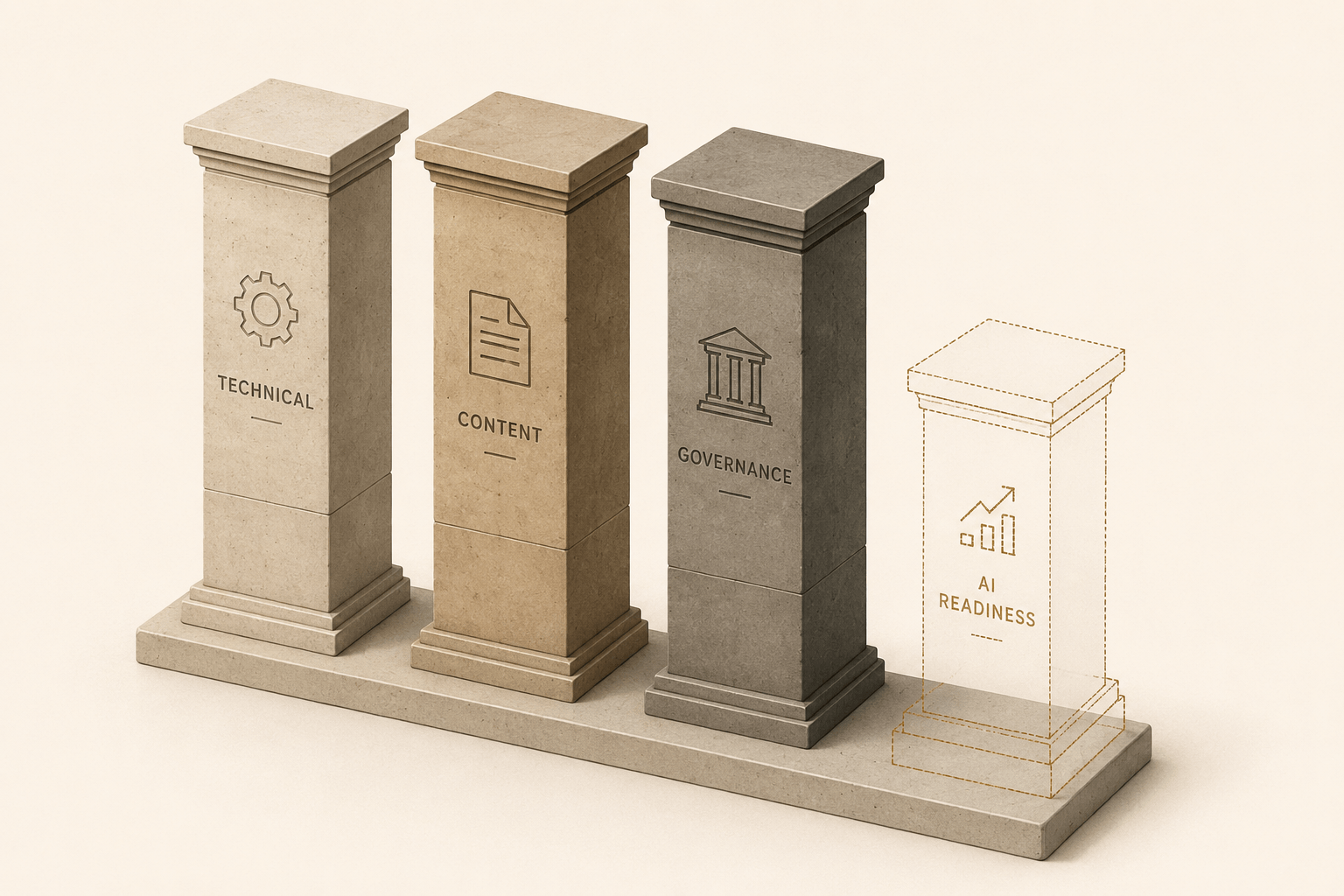
SEO maturity is four things measured together. Assess fewer than four, and you get an incomplete picture every time.
Technical Execution covers your on-page fundamentals and site infrastructure: crawlability, page speed, schema markup, internal linking architecture, and Core Web Vitals. This is what most audits cover. It gets you to the floor of maturity, not past it.
Content Strategy is where most models go wrong. They measure volume: how many keywords you rank for, how many posts you publish. The real dividing line is buyer-intent alignment. Are you ranking for searches where someone is actively comparing solutions and ready to purchase? Or are you attracting researchers who will never convert? A site ranking for 2,000 informational keywords with zero pipeline contribution is not more mature than a site ranking for 200 buyer-intent terms that drive demos.
Organizational Governance covers the question nobody likes to answer: if your primary SEO person left tomorrow, would your program survive ninety days without decline? This dimension is about documentation, cross-team ownership, quality assurance for site changes, and whether SEO knowledge is distributed across the organization or trapped in one person’s head.
AI Search Readiness (GEO) is the dimension every existing framework ignores. Google AI Overviews, ChatGPT, and Perplexity are already influencing buying decisions. Does your content show up in AI-generated answers? Is it structured for citation? Companies that build this capability now will secure positions that get significantly harder to earn later.
No existing SERP result includes AI search readiness. No existing result merges execution with governance. That’s why your previous self-assessments gave you inconsistent results. Each one was measuring a different slice.
The 5 SEO Maturity Levels: Where You Stand Today
Level 1: Reactive. SEO happens accidentally. You have a website, some content exists, but there’s no documented strategy, no keyword targeting methodology, and no one owns organic as a channel. Technical health is unknown or ignored. Content is created based on internal assumptions, not buyer research. AI search visibility is nonexistent. Organic drives less than 5% of pipeline.
You’re here if the CEO asks, “how is our SEO performing?” and you can’t give a structured answer.
Level 2: Foundational. Basic SEO hygiene is in place. Obvious technical issues are fixed. You’re targeting keywords, mostly high-volume informational terms, and someone on the team is responsible for organic. Content is generic, often written by freelancers who have never spoken to your customers. No documented processes exist. Organic drives 5-15% of the pipeline, mostly from branded searches.
You’re here if your SEO consultant sends a 40-page audit and six months later, the next audit produces a nearly identical list of recommendations.
Level 3: Structured. A real strategy exists. Keyword targeting includes some buyer-intent terms, not only informational volume plays. Technical SEO is monitored regularly. Content production follows a loose process, though it still depends heavily on one or two people. Governance is emerging but informal. AI search is on the radar, but not systematically addressed. Organic drives 15-30% of the pipeline.
You’re here if you have traction but feel stuck between tactical execution and strategic impact.
Level 4: Integrated. Content strategy is built around buyer intent at every stage of the decision process. Technical SEO is maintained proactively rather than reactively. Documented processes govern content production, site changes, and quality assurance. SEO knowledge is distributed across the team. GEO is being actively incorporated. Organic drives 30-50% of the pipeline with clear attribution.
Level 5: Systematic. Every piece of content has a defined job: attract a specific buyer persona at a specific decision stage, answer their actual questions using real product knowledge and customer insight, and move them toward conversion. AI search visibility is built into content production by default. Governance is robust enough that no single person’s departure can collapse the program. Organic operates as a predictable, scalable revenue channel.
If you’ve identified where you stand and want a structured plan to advance, book a growth assessment to get a professional diagnosis across all four dimensions.
How to Move From One Level to the Next
Every SERP result tells you where you are. None of them tells you what to do about it. The specific actions for each transition:
Level 1 → Level 2 (30-60 days)
- Run a technical audit and fix crawl errors, broken links, and missing metadata. Table stakes.
- Assign one person explicit ownership of organic search. The answer has to be a name on the org chart, not “marketing handles it.”
- Build an initial keyword map targeting 20-30 terms where buyers are searching, not where researchers are.
Level 2 → Level 3 (60-120 days)
- Shift content targeting from volume keywords to buyer-intent keywords. If a keyword attracts people who will never buy, stop prioritizing it.
- Document your content production process. Who approves topics? Who writes? Who reviews? If this lives in someone’s head, it doesn’t exist.
- Establish a governance checkpoint for site changes that affect search visibility. The scenario is real: a development team pushes a redesign that breaks URL structures, removes canonical tags, and eliminates the sitemap. Organic traffic drops 35% before anyone notices. A single approval step prevents this.
Level 3 → Level 4 (90-180 days)
- Rebuild content around customer interviews and real product knowledge rather than surface-level research. This is the dividing line between content that ranks and content that converts.
- Distribute SEO knowledge across the team through documentation and cross-training. If your SEO person goes on leave and nobody can maintain what they built, you aren’t at Level 4.
- Begin structuring content for AI search citation: clear definitions, structured data, direct answers to specific questions.
Level 4 → Level 5 (6-12 months)
- Build GEO into every content production workflow so AI visibility happens by default.
- Establish attribution from content to pipeline to revenue. Every article should have a measurable job.
- Stress-test your governance. Simulate a key person leaving and verify the program continues without decline.
The Maturity Dimension Nobody Is Measuring: AI Search Readiness
GEO belongs in any maturity model built for 2026 and beyond. AI search adoption is accelerating, and the companies building this capability now are securing positions that get harder to earn with each quarter that passes.
What AI search readiness looks like at each level:
At Levels 1-2, you have no AI visibility strategy. Your content was built for traditional blue-link rankings. You check ChatGPT for your target keywords and find nothing.
At Level 3, you’re experimenting. Some content is structured with clear definitions and direct answers. You’re monitoring whether your brand appears in AI-generated responses. Results are inconsistent.
At Levels 4-5, every piece of content is structured for both traditional search and AI citation by default. You appear in Google AI Overviews and ChatGPT recommendations for your target keywords. AI visibility happens inside content production rather than as a separate workstream.
Self-Assessment: Diagnose Your SEO Maturity in 10 Minutes
Score yourself across each dimension. Be honest. The value is in the diagnosis, not in a flattering number.
Technical Execution:
- Can your site be fully crawled without errors blocking key pages?
- Are Core Web Vitals passing on your top 20 landing pages?
Content Strategy:
- Does your content target keywords where buyers are actively comparing solutions, or mostly informational terms that attract researchers?
- Can you trace a line from a published article to demos, leads, or revenue?
Organizational Governance:
- If your primary SEO person left tomorrow, would your program survive 90 days without decline?
- Is there a documented approval process for site changes that affect search visibility?
AI Search Readiness:
- Does your content appear in Google AI Overviews or ChatGPT for your target keywords?
- Is content structured for AI citation as part of your production process, or as an afterthought?
Your weakest dimension is your priority. Ignore the dimension with the most audit recommendations and the one your agency pushes hardest. Focus on the lowest-scoring one across these questions.
For a rigorous diagnosis, book a growth assessment to get evaluated across all four dimensions with a structured plan to advance.
Why Maturity Models Fail Without Interview-Driven Content and Documented Systems
The gap between mid-level and advanced SEO programs comes down to two things: where your content comes from, and whether your systems survive personnel changes.
Most teams at Level 2-3 publish content written by freelancers who have never spoken to a customer. The output is generic. It ranks for some terms, generates some traffic, and converts almost nobody. The content sounds like every other article on the SERP because it was built from the same surface-level research as every other article on the SERP.
The shift to Levels 4-5 requires content built from customer interviews and internal team expertise. Talk to actual buyers, and you learn the specific language they use, the objections they raise, the comparisons they make. That specificity is what makes content convert. It’s also what AI tools prefer to cite, because the content contains original insight rather than aggregated information.
The second failure point is governance. Search Engine Land’s VGMM model correctly identifies this gap, and most teams still ignore it. When SEO knowledge lives in one person’s head, maturity is fragile regardless of what the scorecard says. Documented processes, repeatable workflows, and distributed knowledge are what turn an SEO program into an organizational capability rather than a personal skill.
Your Next 90 Days
The real measure of SEO maturity is whether your organization can consistently turn organic visibility into revenue and sustain that capability regardless of who’s on the team or how search evolves. Rankings and traffic are downstream of that.
Your next step: run the self-assessment above, find your weakest dimension, and focus your next 90 days on the transition actions for that one dimension. Don’t try to fix everything at once. Maturity gets built one level at a time.
If you want a professional diagnosis across all four dimensions with a structured plan to advance, book a growth assessment.